For more than 20 years, the dog training industry has been locked in a fight between force-free and balanced approaches. Most of that fight has been noisy, emotional, and largely beside the point. We argue about tools, studies, competition scores, and who is more scientific, while the actual disagreement remains poorly named. This is now my attempt to name it clearly.
Unlike a verbally competent human, a dog cannot learn about hypothetical future consequences through explanation alone. To establish direct, action-specific avoidance, the consequence must be represented somewhere in the dog's learning history through experience with an aversive contingency, or with a signal that acquired meaning by predicting one.
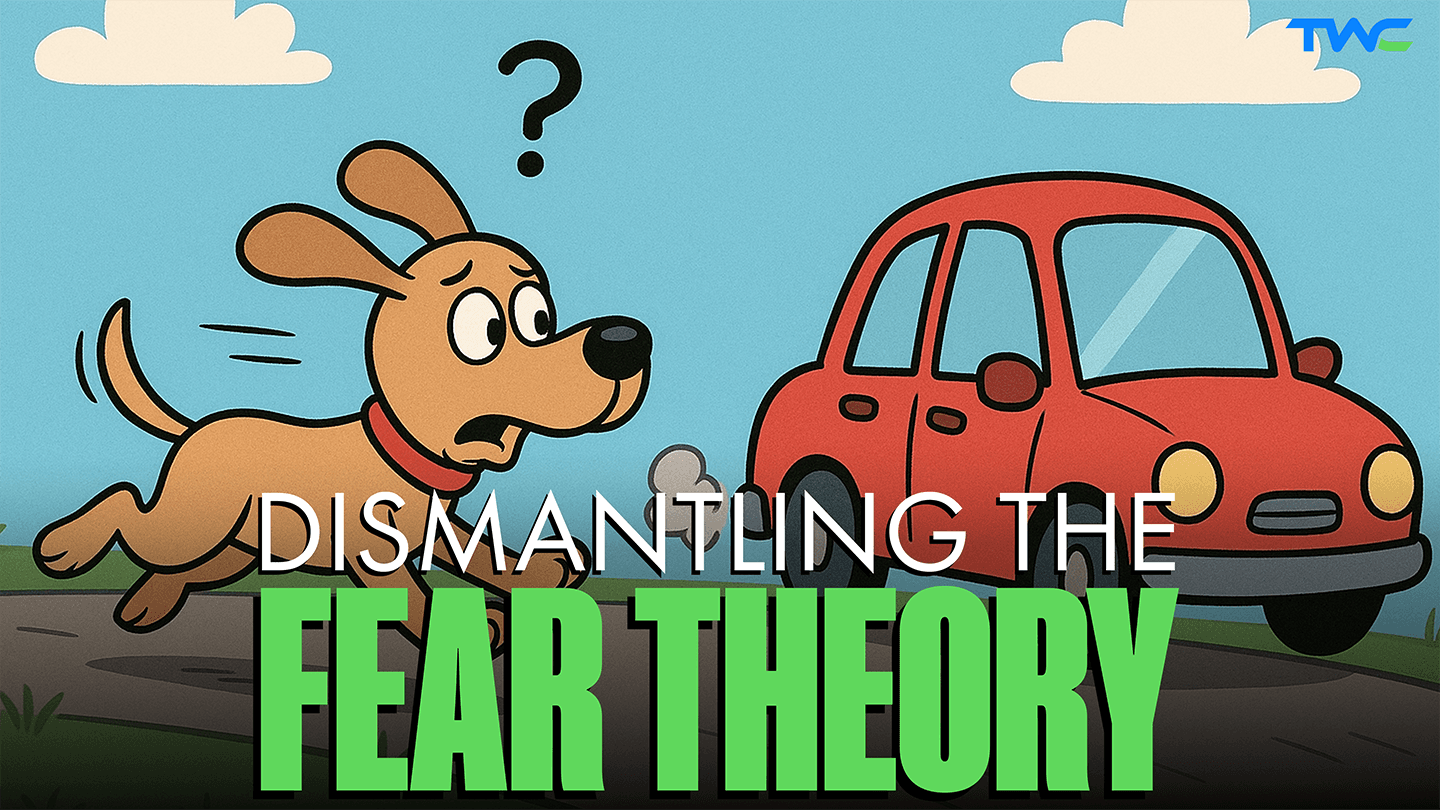
Any intelligent parent can tell a child in advance that cars are dangerous, how traffic lights work, where to look, and what can happen if the child runs into the street. Here, the instruction precedes the experience. Dogs have no equivalent channel. Categorical force-free methods reject deliberately adding an adverse consequence to the prohibited action. They may communicate opportunity costs, non-reinforcement, restraint, and redirection, but they do not intentionally establish the prohibited action itself as predicting an added aversive consequence.
These procedures can be highly effective at producing alternative behaviors and changing a dog's emotional response to the trigger. A dog can learn to sit and look at the handler when a car appears, and the performance can look excellent. Yet the dog has still not been given the information that approaching or interacting with the car itself carries a cost.
Basically, the method has successfully deflected the dog, but it has not explained the danger.
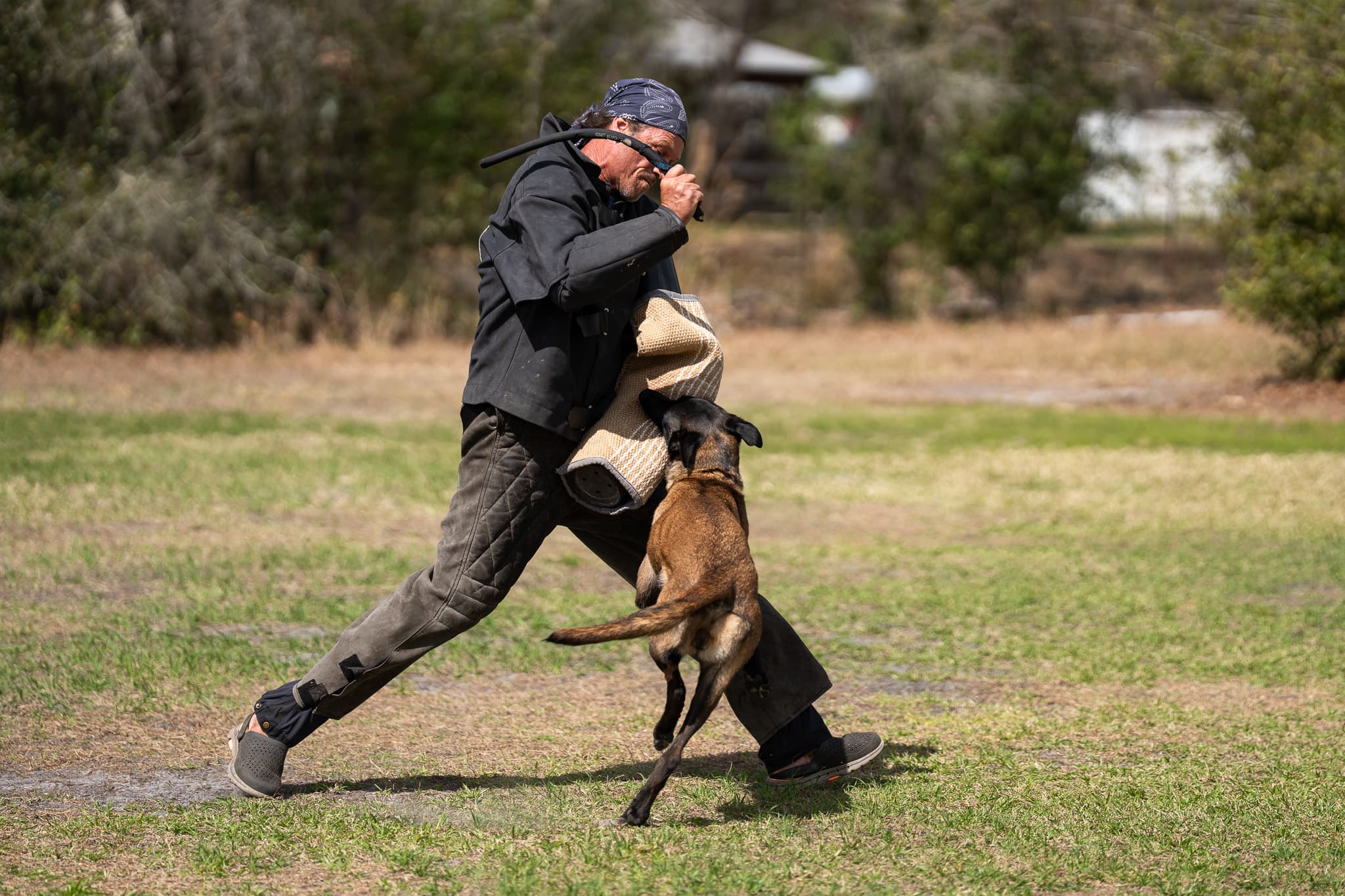
Balanced training can provide the information that force-free ideology categorically refuses to provide. In a physically controlled setup, we can arrange the consequence so the dog can associate the cost directly with approaching or interacting with the dangerous object, not simply with the owner saying, “I don't like you doing that with a vehicle.” The car's, not the handler's, disapproval must become the relevant predictor.
We are not merely interrupting a chase. We are building independent avoidance of the danger. The intensity is not determined by ideology or by an arbitrary number on the electric collar. It must be meaningful enough for that individual dog to care, but of course, no stronger than necessary to create clear learning. The trainer watches the dog, not the remote control.
In some cases, one or two additional applications may be needed while the association forms.
The same learning principle is easy to see in an ordinary household example involving electric cables. When the timing and criteria are clean, the result is specific learning. The puppy can later lie next to the cables, rest its head on them, and remain relaxed in the same room, yet no longer chew the cables.
The environment is safe. The action is not. This is not non-contingent, delayed, or extreme punishment. It is the dog receiving information that verbal explanation cannot provide.
Let's imagine playing the hot-and-cold game while refusing to use one entire category of negative feedback. We basically don't have the cold. The learning can still progress through reinforcement, non-reinforcement, resets, lots of opportunities, and so on. But the instructor has prohibited the clearest form of feedback that a specific choice carries an added cost. Force-free training plays the game under that exact restriction, and balanced training does not.
Dogs, like any learners, benefit from clear information in both directions. A complete instructional system has access to both: this works, and this carries a cost. Categorical force-free training removes that second message by design.
This is true for high-stakes, dangerous situations and for ordinary training alike: pet dogs, service dogs, and sport dogs.
Negative punishment. Let's talk about negative punishment. I know it's going to come up. It is often very powerful and, in some situations, the cleaner tool. Removing access, opportunity, or a valued reinforcer can change behavior effectively. But it also has well-known limitations. It requires something the dog already values that we can remove.
Against highly self-reinforcing or instinctive behaviors, it is frequently slow and very often insufficient. It still does not create the same direct association in which the action or stimulus itself predicts an added aversive consequence. Both forms of consequence can belong in a complete education.
Neither is appropriate or sufficient in every situation. That should be clear.
Of course, there is risk. There is risk in every method when applied with poor timing, poor criteria, or poor understanding of the dog's emotional state, motivation, and so on.
A poorly designed reinforcement approach can strengthen unintended behavior, create excessive arousal or frustration, increase conflict around valuable resources, or produce dependence on visible rewards. On the other hand, incompetence with an aversive can create fear, confusion, generalized suppression, or suppressed warning signals.
Misconduct alone does not prove that all competent use of a method should be prohibited. The existence of abuse justifies accountability for abuse. It does not automatically justify criminalizing responsible use.
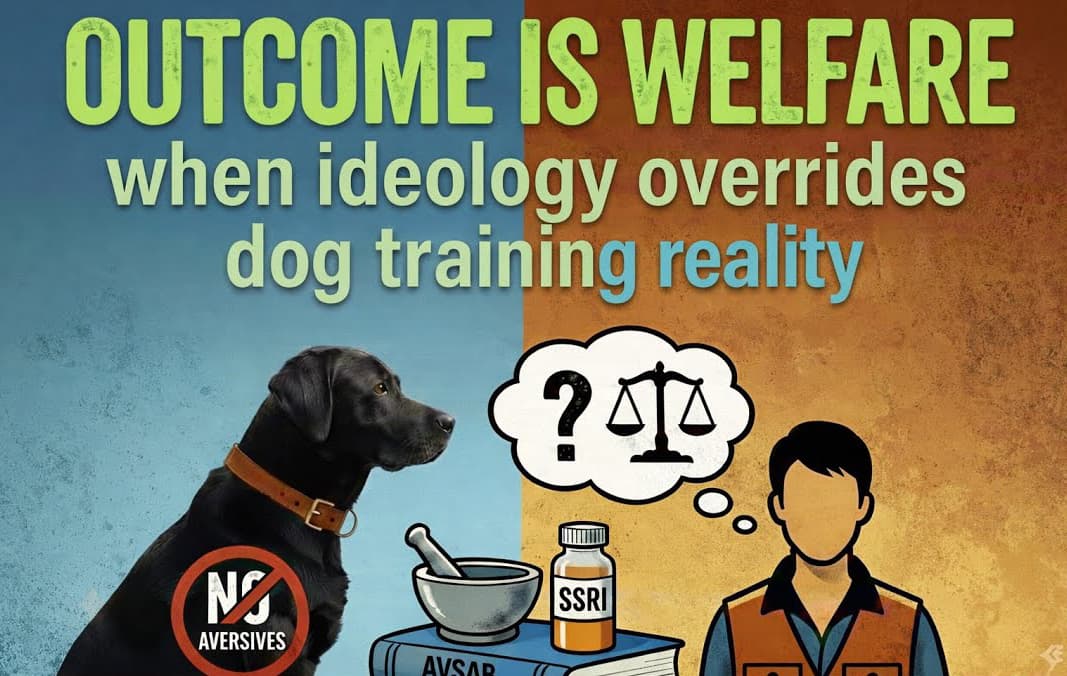
Whatever rationale organizations such as the AVSAB offer, the operational consequence of their position is that intentionally added aversive feedback is removed from the trainer's permissible instructional repertoire under every circumstance.
In practice, bans can drive the practice underground, remove it from open professional discussion, and make high-quality education harder to obtain. So how does that help? That creates conditions for more incompetent application, not less.
The rational response to real risk is better education, clearer standards for contingency and timing, and honest examinations of both the benefits and the failure modes.
At the most basic biological level, living organisms approach what benefits them and avoid what harms or costs them. You can call it a biological law, a survival principle, an adaptive mechanism, or whatever. The terminology does not change the reality. Life depends upon both approach and avoidance. Dogs are intelligent enough to use information in both directions.
Refusing to allow them access to one direction is not a neutral choice.
Let me get back to the parent, child, and car example. Imagine if the parent were very successful in teaching the child what to do on the street, but never explained the danger of cars.
Would you like to know if something is dangerous or not?
I mean, does that knowledge matter to you? If the answer is yes, then explain why an intelligent dog should be categorically denied the only kind of learning through which that future consequence can be represented directly. Is it ethically legitimate, and sometimes ethically necessary, to teach a dog directly that a particular choice carries an aversive consequence?
Categorical force-free training optimizes for avoiding deliberately added discomfort, and therefore it has to rely on prevention, redirection, alternative behaviors, opportunity cost, and management.
Balanced training, at its best, preserves the full instructional repertoire and optimizes for clarity for the dog itself: learning both what works and what happens when a particular action is off-limits or carries a genuine cost.
Sure, both can produce reliable behavior. However, they do not necessarily transmit the same information. And that is what we have been fighting for the last 20 years.
I think once that difference is stated this plainly, the rest of the debate becomes secondary. The industry can continue to argue about tools, studies, risk tolerance, and so on, but it shouldn't continue to pretend that the informational gap does not exist.