Alright guys, welcome to another solo podcast. Today I want to talk about a recent post by Michael Shikashio, who is a highly regarded aggression expert in the force-free community. I've had Michael on my podcast before. At the time, I thought it was a pretty good conversation. Solid conversation. Two trainers with different views just sharing and exploring ideas. I follow his work the same way I follow many trainers out of professional curiosity. Not necessarily agreement. I'm always looking for angles I might have missed.
After our podcast, something changed. Michael started walking back points he openly shared on the podcast. Maybe it was a backlash from his own community. Maybe pressure to stay aligned with the ideology he represents? I don't know, it doesn't necessarily matter. I invited him back for a second discussion. He declined politely with something like, you know, “it's not the right time. Maybe sometime in the future.” Something like this. So months later, I reached out again. But now there was no more response and. Fine. I mean, that's his choice. You either want to challenge ideas or you don't. The more I watch some of his presentations and, you know, it just becomes quite obvious he has a very polished message. However, it's really built on a very fragile model.
Then recently, I saw the post I want to talk about to you today. Someone forwarded it to me from, I think it was Instagram. And here's what he said word for word.
“Resource guarding is not about control. It's about fear and uncertainty. Dogs guard not to be in charge, but to keep something safe. The growl, the freeze. The hard stare. These aren’t defiance, they’re discomfort. Dogs don't guard because they are bad. They guard because they fear losing access. When safety and predictability increase, guarding decreases.”
It sounds compassionate. It sounds humane. It sounds deep. However, it's really, really not accurate. It's comforting language, but it's built entirely on correlation and not causation. Yes, sometimes when a dog feels safe or guarding decreases. But that doesn't mean safety fixes the mechanism. In many cases, safety simply removes the opportunity for conflict. It does not change the system driving the behavior, and that's something to pay attention to. And if you don't understand the system, you end up treating symptoms instead of the actual structure. And here is the core problem with the “it's all fear” narrative.
If everything is fear, then nothing is fear. That's the disease in the force free ideology.
Basically collapsing every behavior - guarding, aggression, competition, negotiation, frustration, possession into one magical category. Fear. Play becomes fear. Curiosity becomes fear. Competition becomes fear. Even courage becomes fear in disguise. And of course, it feels moral. It feels therapeutic. It feels compassionate, but it collapses the behavior model into complete nonsense.
Real behavior science is based on differentiation, like different motivation, different predictions, different interventions. If we don't understand the motivation, then we're just guessing. That one line in his post, where he says a growl is communication. Of course it's correct. Nobody can argue with that. A growl is communication. But here is the part that conveniently, it's put aside. Obedience is also communication. Disobedience is also communication. Obedience says I agree. Disobedience says I don't. A growl says, here is my position. Communication does not mean justification. Communication does not mean leave it alone and you do not punish the growl.
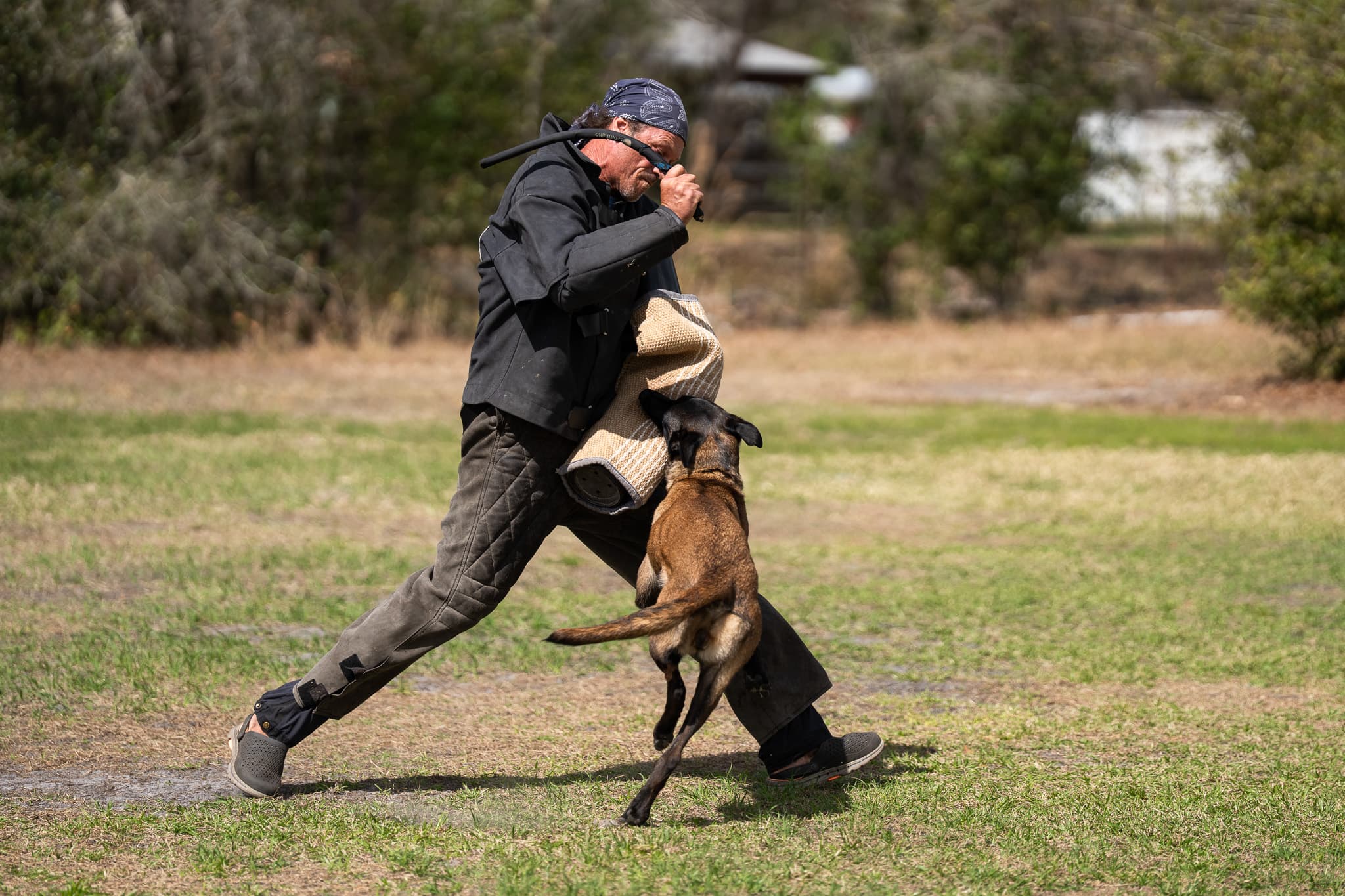
Let's be clear. You acknowledge it. You analyze the function and then address the system. And here is what actually is happening in most guarding cases. The dog has learned that controlling others works. And that is operant behavior all day long. Every time someone retreats, the dog is reinforced. Most owners accidentally train guarding not by confronting the dog, but by backing away. Ironically, this is the exact principle we use when training young protection dogs. The dog pushes forward. The helper yells. It's the foundational work in bite sports. That's how we start.
Fear may start guarding in some dogs, but control maintains guarding in many more. This basically brings us to the actual structure beneath the behavior. Two motivational systems. They look identical from the outside. One is the fear, the defensive avoidance, the dog guards to prevent loss or harm. However, as soon as safety returns, that loop closes. The second one is competition. It's strategic control. The dog guards to win a negotiation. And here the loop, if you want, closes only when hierarchy is established.
Psychologically, these are totally different engines. Fear crashes the HRV - the heart rate variability. The system basically locks up. Fear spikes cortisol. Competition, on the other hand, raises testosterone, sharpens focus, increases persistence. Fear says “I'm in danger.” Competition says, “let's see who's steering the wheel.”
At my school, for dog trainers I talk about the 15 second rule. It's a really cool, simple diagnostic tool if you want. And basically, if you are dealing with a resource guard and you are evaluating, if you pause, if you just step back and remove the pressure, a fearful dog relaxes within more or less 15 seconds. The system shuts off fast when the danger is gone. It's done.
A competitive dog, on the other hand, stays locked in. What I mean by this, he holds the claim. He watches. He's waiting. And not because he's scared, but because he wants confirmation of influence. Fear ends when safety returns. Competition ends only when control is clarified. And that single difference teaches you more than any body language chart and any webinar, if you want.
Here is where the industry as a whole fails. It's a really interesting one. And let me know what you think. The force-free trainers, they assume that as I said, everything is fear. Many of the so-called balanced trainers. They assume that everything is control. They're both sometimes right by accident. When the motivation matches the ideology, either one succeeds. When it doesn't, the dog gets destroyed. A fearful dog under the wrong balanced trainer, of course, is going to shut down, and most likely that trainer is going to claim success, which is the sad, unfortunate truth. A competitive dog in the “just make him feel safe” training becomes a tyrant and most likely ends up in for euthanasia.
That's not skill, that's luck. Real training requires diagnosis, not ideology. When the two dogs negotiate rank, it's not fear, it's not pathology. It's not trauma. It's a normal mammalian social structure. A fearful dog pushes the threat away and then relaxes. A competitive dog pushes the threat away and then waits. He wants that confirmation. That's not fear. That's strategy. Hierarchy often forms quietly through micro postures, subtitle displays, and tiny rehearsals of influence. Nothing dramatic. Nothing abusive. As I said, just social mammal structure. Resource guarding is one of the cleanest strategies animals use to establish or adjust hierarchy. It's safer than a direct fight. Dogs deliberately argue over an object. Sometimes it's completely symbolic because it keeps the conflict controlled by competing for possession, they make a statement about rank without escalating to serious injuries.
I had a Yorkie for 13 years. His name's Samson. He came to me because he was seven months old. He was living with his sister, with the family, and he was bullying the female puppy. His sister. The owners searched for help. I ended up going through an animal veterinarian behaviorist. Of course, a seven month old. He was on fluoxetine. He came for training. I really liked him. I'm like, “let me just have him. You already have one. And they're not getting along.” Sometimes it's just the right thing to do. It was a relief for that owner, and I was super happy because Samson was a very, very cool little guy.
The story that I want to tell you is when he first came, he was this classical Yorkie that, you know, you open the door, and if he was called, he's not going out. It was raining. He's not going. It's just, like, very, acting like any city little dog. We have a lot of intact malinois that live in the house and he had to fit in. He didn't just fit in. He was a really cool dog. And he basically put, like a master class on how to work up his way and how to create some authority. Like you can think of it as a master class in strategic competition. So what he was doing, like, what was his strategy?
He would have a toy. And then one of the bigger dogs will walk by him. They could care less about what he has or what he does, but Samson would be like, “oh, this, my toy. Stay away.” Nobody cares. They just go and do their own thing. He kept doing this and eventually I saw him taking it a step further. And the step further was very interesting, because now it wasn't that he had something already that he says, “this is mine”, but he actually would claim something else. So, for example, let's say there was whatever toy you think of somewhere in the middle of the room and there is a big dog and there is Samson on the other end. Samson would run and grab that toy like he's competing against the other dog, while the other dog could care less what he's doing, but he will just grab it and snatch it and he's like, “cool, I beat you to it and it's mine. And don't you dare to try to take it” and stuff like that. While once again, any of the other dogs really couldn't care.
He was smart in that he didn't really challenge the big dogs when they had something they cared for. That was, as I say, that master class that he put up. So after a little while, he ended up taking it to another step. Now he would see one of the dogs laying down, but there is a toy next to it. The dog doesn't care about that toy. Again, that was a very important part of his strategy. But he would go there and he once again would just kind of grab it. “And it's like this is mine, not yours.” He really worked his way up. Like, little by little, he really worked his way up, and he was able to assert himself. That strategy is what really created his place where he is. And again, he never really tried to take something of value from the other dogs, but for the most part, he was totally in control. Like he can tell any of them to get away or to whatever, like he was. He was super, super cool and his strategy was just brilliant.
You know, again, he convinced much larger dogs that if he wanted something, he could take it, even if the big dog had it first. Now, what is important where I'm going with this is. That's not fear. That's pure social strategy. And this is the kind of behavior, the fear-only narrative falls apart cannot explain. When two dogs want the same rank, the conflict continues until it is resolved. In nature, if it's not resolved, one of the dogs is going to leave. In a home, they cannot. So, the relationship kind of becomes trapped if you want. And here is the part that I think destroys the whole avoid conflict philosophy, avoid conflict idea. When you prevent conflict for competing dogs, you prevent resolution. Avoiding conflict does not create peace. It creates uncertainty. Uncertainty creates more guarding, more tension, more stress.
A lack of hierarchy is really the home of instability. This is why many force free trainers unintentionally war some competitive guarding, competitive resource guarding because they remove the confrontation, which is the exact mechanism that resolves status disputes. Resource guarding is not all fear. It's also not all dominance. It's not one thing. It's functionally diverse. Safety helps fearful dogs. Structure helps competitive dogs.
You give the wrong intervention to the wrong systems and you strengthen the problem. Fear ends when safety returns. Competition ends when order is established. Confuse the two and you're not going to fix either one.